

Learning flash cards are a versatile and effective educational tool that can benefit various age groups. As a supplier of learning flash cards for kids, I have witnessed firsthand the positive impact these cards can have on children's learning and development. In this blog post, I will explore the different age groups for which learning flash cards are suitable and how they can be used to enhance learning at each stage.
Infants (0 - 12 months)
For infants, learning flash cards serve as a visual and sensory introduction to the world. At this age, babies are developing their visual perception and cognitive skills. High - contrast flash cards with simple shapes, bright colors, and large images are ideal. These cards can capture their attention and stimulate their visual senses.
Research has shown that infants as young as a few months old can start to recognize patterns and colors. Flash cards with black - and - white geometric shapes, such as circles, squares, and triangles, can be used to help infants focus their eyes and develop their visual acuity. As they grow older, introducing colored flash cards with pictures of animals, fruits, or everyday objects can expand their knowledge of the world around them.
Parents can use these flash cards during playtime or while feeding the baby. Hold the card in front of the baby's face at a comfortable distance and slowly move it from side to side to keep their attention. You can also make simple sounds or say the names of the objects on the cards to help the baby associate the visual image with the corresponding word.
Toddlers (1 - 3 years)
Toddlers are in a stage of rapid language development and exploration. Learning flash cards can play a crucial role in enhancing their vocabulary, language skills, and cognitive abilities. At this age, flash cards with pictures and corresponding words are highly effective.
Toddlers are eager to learn new words and imitate what they hear. Flash cards can be used to teach them basic vocabulary, such as animals, colors, numbers, and shapes. For example, showing a flash card with a picture of a dog and saying "dog" repeatedly can help the toddler learn the word. You can also ask the toddler to name the object on the card, which encourages them to speak and practice their language skills.
In addition to vocabulary, flash cards can also be used to teach simple concepts. For instance, cards with different numbers can be used to introduce counting. You can show the card with the number "1" and say "one", then show the card with "2" and say "two", and so on. This helps the toddler understand the concept of quantity.
Flash cards can be made more interactive for toddlers. You can play games like "find the card" where you ask the toddler to find a specific card from a pile. This not only makes learning fun but also improves their memory and concentration.
Preschoolers (3 - 5 years)
Preschoolers are at a stage where they are preparing for formal education. Learning flash cards can be used to reinforce the skills they are learning in preschool, such as reading, writing, and basic math.
For reading, flash cards with letters and simple words can be very helpful. You can start by teaching the letters of the alphabet, both uppercase and lowercase. Then, introduce simple three - letter words. For example, show a card with the word "cat" and sound out the letters "c - a - t" while pointing to each letter. This helps the preschooler learn the sounds of the letters and how they combine to form words.
In math, flash cards can be used to teach addition, subtraction, and basic number recognition. For example, you can have cards with simple addition problems like "2 + 1" and the corresponding answer "3". This makes learning math more engaging and less intimidating for preschoolers.
Flash cards can also be used to teach social and emotional skills. Cards with pictures of different emotions, such as happy, sad, angry, and scared, can be used to help preschoolers recognize and understand their own emotions and the emotions of others.
School - age children (6 - 12 years)
School - age children can benefit from learning flash cards in a more advanced way. Flash cards can be used to study various subjects, such as science, history, and foreign languages.
In science, flash cards can be used to learn about different animals, plants, and scientific concepts. For example, cards with pictures of different species of animals and their characteristics can help children learn about the animal kingdom. In history, flash cards can be used to learn about important events, dates, and historical figures.
For foreign language learning, flash cards are an excellent tool. They can be used to learn vocabulary, grammar rules, and pronunciation. For example, a card with a word in a foreign language on one side and its translation in the native language on the other side can help children learn new words. You can also use flash cards to practice conjugation of verbs or other grammar structures.
Flash cards can be customized for school - age children. They can be made with more detailed information and complex concepts. Teachers and parents can also use flash cards as a review tool before tests or exams.
Complementary Products: Talking Pens
To enhance the learning experience with flash cards, we also offer a range of talking pens. These talking pens are a great addition to our learning flash cards. They can bring the cards to life by providing audio explanations, pronunciation guides, and interactive learning features.
For example, our Talking Pen Manufacturer Smart Gift For Kids is a high - quality product that can be used with our flash cards. It has a built - in speaker and can read out the words and information on the cards, which is especially helpful for younger children who are still learning to read.
Our English Talking Pen Sound Book is designed specifically for English language learning. It can be used with flash cards to teach English vocabulary, pronunciation, and grammar. The pen can play sounds, songs, and stories, making learning English more fun and engaging.
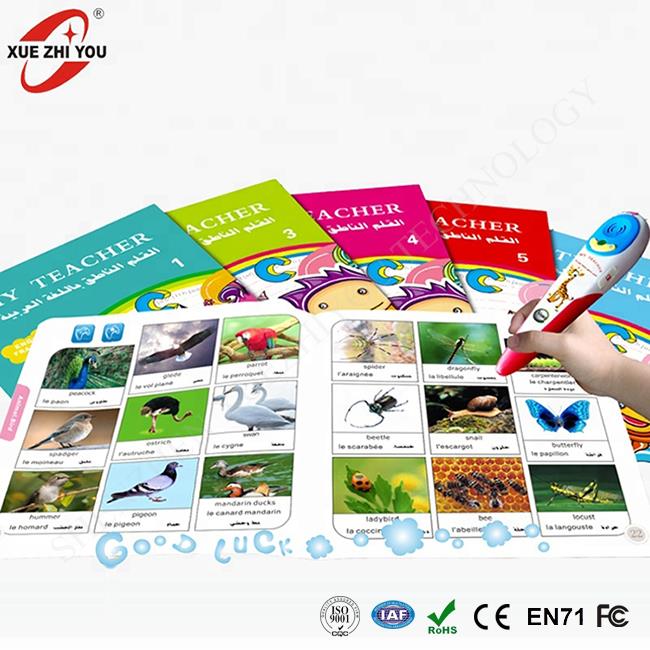

The Talking Pen For Kids Learning Musical Toy is another great option. It combines learning with music, which can help children stay motivated and interested in learning. The pen can play musical notes and rhythms while teaching various concepts on the flash cards.
Conclusion and Call to Action
Learning flash cards are a valuable educational tool for children of all ages. Whether you have an infant, a toddler, a preschooler, or a school - age child, there are flash cards and complementary products available to meet their learning needs.
If you are interested in purchasing our learning flash cards for kids or any of our talking pen products, we invite you to contact us for more information and to discuss your specific requirements. We are committed to providing high - quality educational products that can help children learn and grow.
References
- Piaget, J. (1952). The Origins of Intelligence in Children. International Universities Press.
- Vygotsky, L. S. (1978). Mind in Society: The Development of Higher Psychological Processes. Harvard University Press.
- National Association for the Education of Young Children (NAEYC). (2020). Developmentally Appropriate Practice in Early Childhood Programs Serving Children from Birth through Age 8. NAEYC.